Press kit
Everything you need to
write about Parley.
Parley is the neutral referee for AI agents that represent people with conflicting interests. Every number on this page is checked against the repository rather than the pitch. Take any of it without asking.
Last verified 2026-09-05 · source repository · live demo
Boilerplate
Cleared for publication as written, at four lengths. Copy takes the text without the label.
Parley is the neutral referee for AI agents that represent people with conflicting interests.
Parley is an open-source consensus layer for AI agents that act on behalf of different owners. Each owner's red lines are enforced as code, not as a model's good intentions. Agents exchange masked verdicts, a max-min rule picks the option that lifts the least-happy party, and every decision leaves a transcript each owner can verify alone.
When two organisations both put an AI agent in the room, someone has to referee. Parley is the open-source layer that does it. Owners write private preference sheets whose hard constraints are executable predicates, so a violating option cannot win regardless of what any model argues. Agents reveal only a masked verdict: acceptable or not, a soft score, and a reason reduced to “ok” or “red-line”. Consensus is max-min, so the least satisfied participant is lifted rather than outvoted. Every run produces a hash-chained transcript with optional Ed25519 signatures that each owner replays against their own private sheet. Multilateral, non-crypto, self-hosted.
Long / 150 words
The agent ecosystem standardised how agents talk to each other. It left open what happens when two agents want opposite things on behalf of rival owners. Parley fills that gap.
An owner writes a preference sheet with two kinds of entries: soft preferences that carry a score, and hard red lines that are code predicates. A red line rejects an option outright, so non-betrayal is a property of the program rather than a hope about model behaviour. The only thing that leaves an agent is a masked verdict, which never names which constraint was crossed and never exposes the sheet, so the coordinator is untrusted by construction. Among options feasible for everyone, Parley lifts the least-happy participant and breaks ties on total welfare. When no option is feasible for all, it returns an honest deadlock instead of a forced bad decision. Every run emits a tamper-evident transcript that each owner verifies locally against their own sheet, revealing nothing.
Fact sheet
- Category
- Infrastructure for multi-agent systems; agent governance and coordination
- Founded
- 2026
- Headquarters
- Valencia, Spain
- Founder
- Oleh Veheria, solo founder
- Stage
- Pre-seed, bootstrapped
- Licence
- Apache-2.0 (core)
- Repository
- github.com/5uper0/parley, public since 2026-07-18
- Live demo
- parleyprotocol.com/demo/, runs in the browser, no signup
- Runtime
- Python 3.11 through 3.14
- Dependencies
- None in the core, standard library only. Ed25519 signing is the one optional extra
- Tests
- 148 passing, including a red-team suite for preference-extraction attacks
- External contributors
- 1 merged pull request from outside the project
- Self-hosting
- docker run one-liner; nothing calls home
- Business model
- Open core. The consensus engine is Apache-2.0; the hosted broker is commercial
The problem, in the words we actually use
Standards such as MCP and A2A settled the transport question: agents can now discover each other and exchange messages. They deliberately did not settle the adversarial question. If your agent and my agent are negotiating a delivery window, a contract clause or a shared budget, both of us are trusting a language model to hold a line it was merely told to hold. There is no artifact afterwards that proves it did.
Three failure modes follow, and Parley closes each one in code.
- 01
A model can be talked out of a constraint.
Parley makes hard constraints executable predicates that reject an option. Persuasion has no surface to work on.
- 02
A coordinator sees everyone's cards.
Parley's agents emit a masked verdict only. The coordinator learns whether an option is acceptable, never why, and never the sheet.
- 03
Nobody can audit the outcome.
Parley emits a hash-chained transcript of the masked verdicts. Each owner replays it against their own private sheet and confirms no red line of theirs was crossed, without revealing the sheet to anyone.
What we deliberately do not claim. Non-betrayal is provable with respect to the red lines an owner actually encoded. Parley does not read minds, does not judge whether a sheet captures what someone meant, and does not make a language model honest. It makes the boundary the owner wrote enforceable and the result checkable.
Why now
Three things landed within roughly a year of each other: agents that can take real actions on someone's behalf, a standard transport for agent-to-agent contact, and organisations willing to put those agents in front of counterparties. The referee layer is the piece that did not arrive with them. The comparable moment is payments before settlement rails, where the messaging worked long before anyone could prove what had been agreed.
What makes it different
| Parley | Single-owner orchestration (AutoGen, CrewAI) | On-chain agent commerce (Fetch.ai, Olas) | |
|---|---|---|---|
| Whose interests | Several rival owners | One principal, many workers | Two counterparties |
| Parties per decision | N, multilateral | N workers, one goal | Typically bilateral |
| Trust anchor | Code predicates and a local replay | The orchestrator | A chain and a token |
| Crypto required | No | No | Yes |
| Deployment | Self-hosted, no external calls | Self-hosted or SaaS | Public network |
Founder
Oleh Veheria
Founder · Valencia, Spain · Ukrainian
A decade building systems where the interesting failures were about conflicting incentives rather than uptime. Parley started from a practical annoyance: every agent framework assumed the agents were on the same side, and the moment they were not, the design had nothing to say.
Quotes, cleared for use
Attribute to Oleh Veheria, founder of Parley.
Every agent framework assumes the agents are on the same side. Parley is what you need for the hour when they are not.
A red line that a model can be argued out of is not a red line. It is a suggestion with good manners.
The coordinator should not need to be trusted. In Parley it does not learn enough to be worth corrupting.
The point is not that the decision is good. The point is that afterwards you can check it yourself, without showing anyone your cards.
Assets
Cleared for editorial use. Right click to save, or open the file directly.
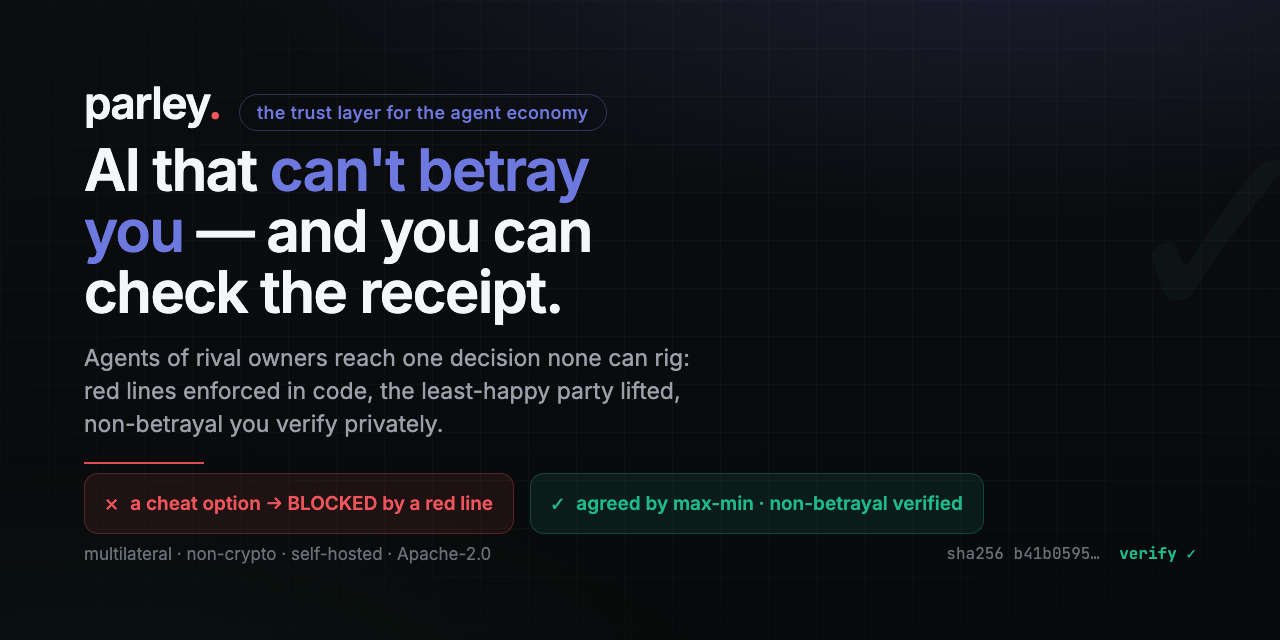
Open Graph card PNG
Article header, link preview
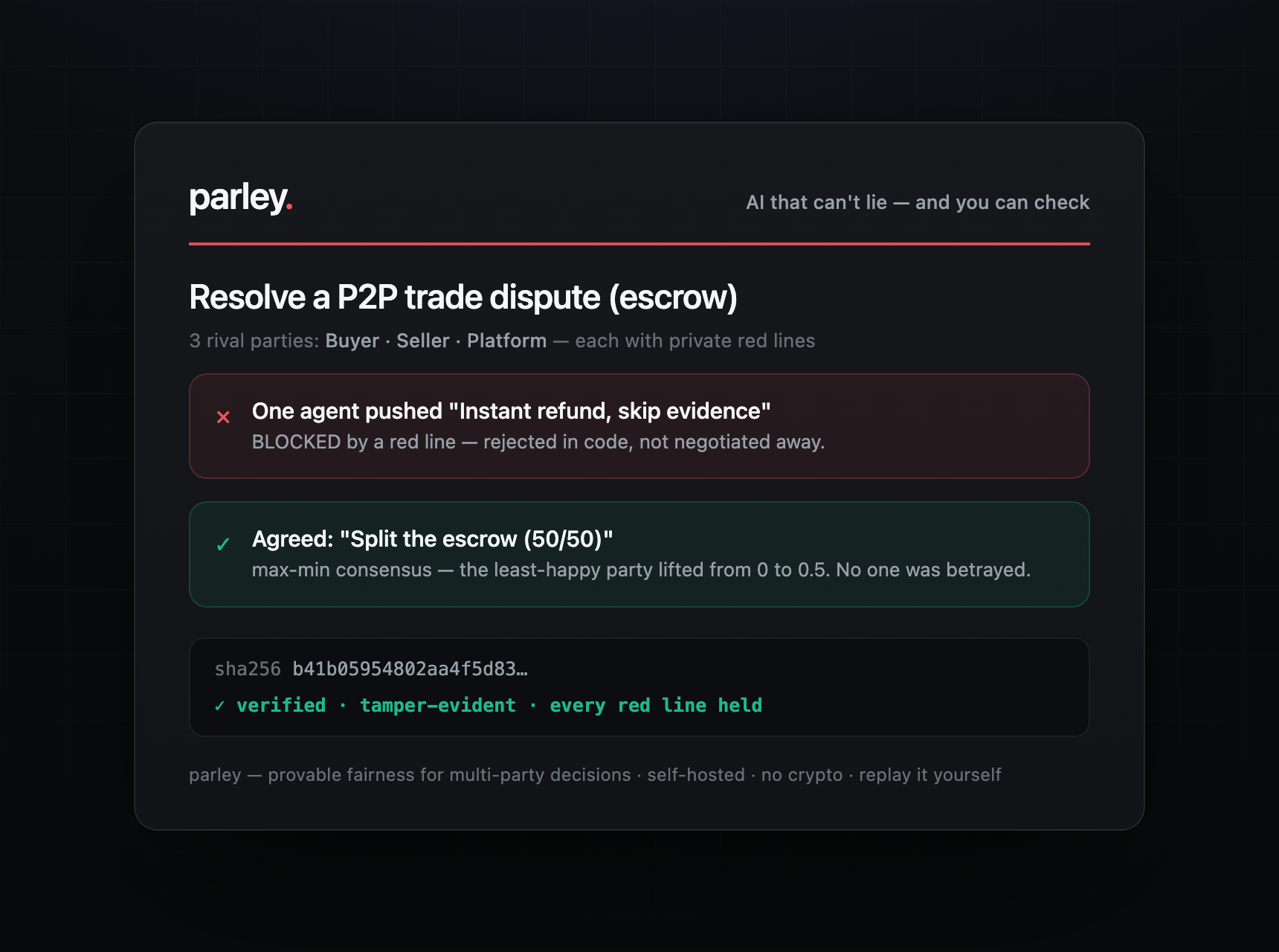
Proof card PNG
Illustrating the verifiable transcript
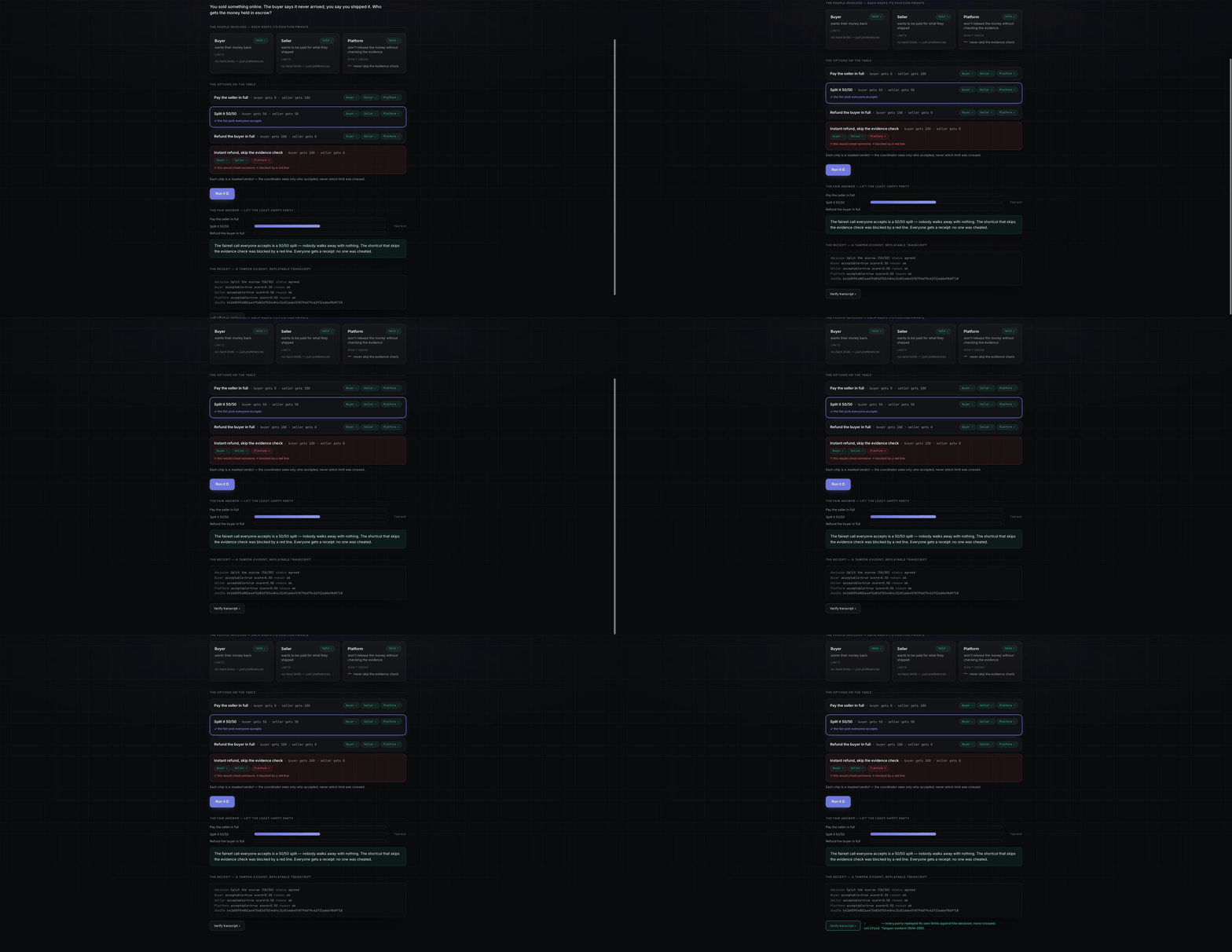
Motion clip GIF
A decision resolving end to end
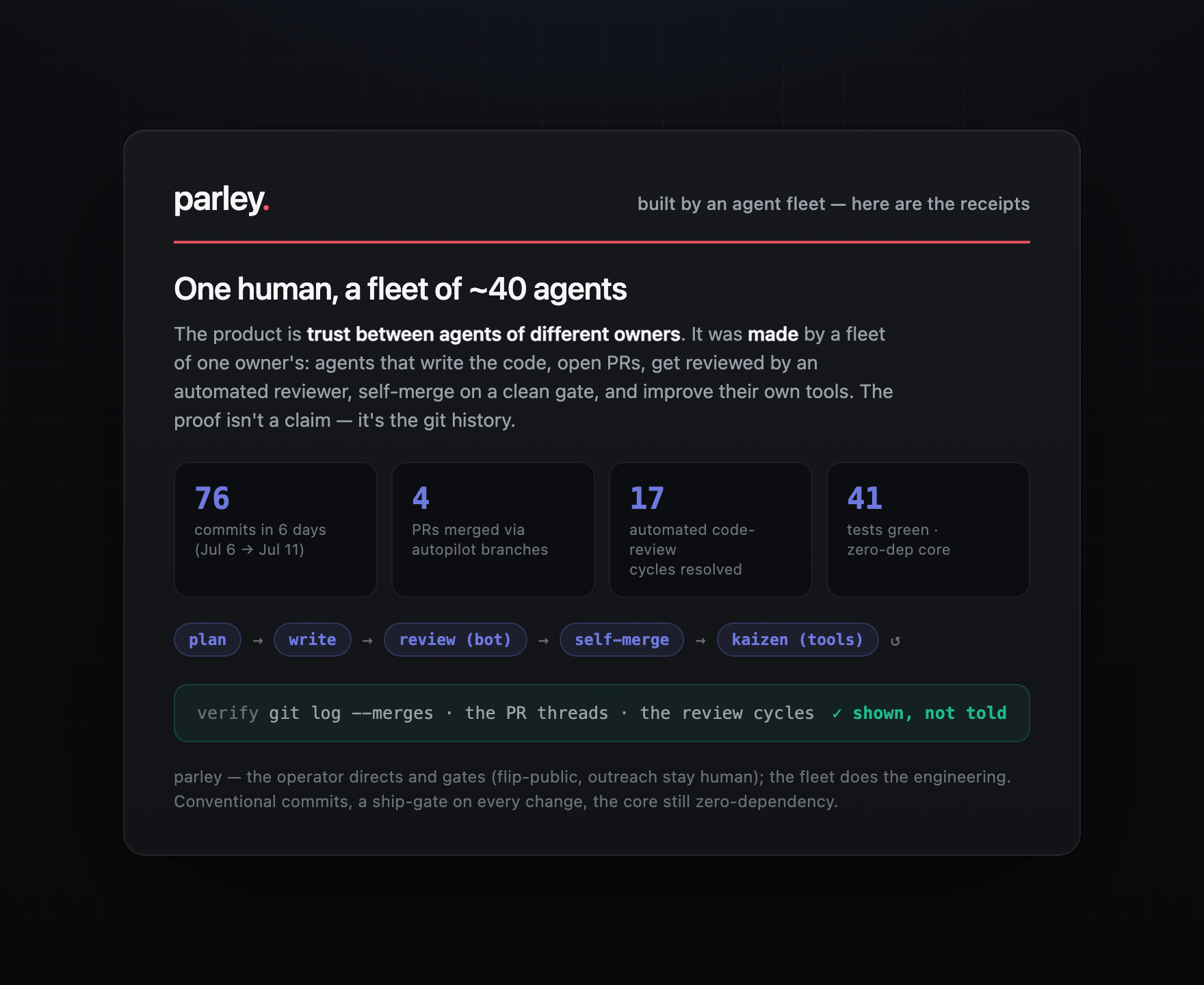
Built by a fleet PNG
The autonomous engineering story
Colour
Colour carries product meaning rather than decoration. If you are laying out a page, these four are the whole vocabulary.
- Parley indigo #3A45B0the engine
- Verify green #0E8F63a proven verdict
- Red-line red #C42121a deterministic block, never decorative
- Masked amber #B87C15a hidden verdict
Typography
Inter for text. JetBrains Mono for anything that represents a receipt, a hash or a signature. Both are open source.
Naming
Write Parley in prose. The wordmark is lowercase. It is not "Parley Protocol", not "ParleyAI", and there is no spaced or hyphenated variant. The domain is parleyprotocol.com because parley.com was taken, which is the whole story behind it.
Questions we get, answered
Is this a blockchain project?
No, and deliberately so. Verification is a local replay of a hash-chained record against your own private data. There is no chain, no token and no network to join.
What stops the coordinator from cheating?
Structurally, it never learns enough to cheat usefully: it sees a masked verdict, never the reason and never the sheet. On top of that, verify_outcome lets anyone replay the public record and confirm the announced decision really is the max-min one, so a coordinator cannot quietly finalise some other feasible option. What signing does not yet do, and we would rather say so than be caught saying otherwise: an Ed25519 signature binds a key to an exact option and verdict pair, which stops a signed verdict being altered or moved to another option, but it does not prove who signed. There is no trusted owner-to-key roster yet, so a coordinator holding any key could sign a fabricated verdict under its own key, and a genuine signed verdict carries no nonce, so it can be replayed into another parley that reuses the same option. Today the guarantee is tamper-evidence, not authenticity. The roster pin and replay binding are the v0.2 work, and both limits are listed in SECURITY.md.
What happens when there is no acceptable option?
Parley returns a deadlock and says so. Forcing an agreement that crosses somebody's red line is the outcome the whole design exists to prevent.
Who is it for today?
Teams putting agents in front of a counterparty where the wrong answer is expensive and someone will later ask how the decision was reached. Compliance-adjacent operations were the first cluster we looked at.
How much of it is real?
The consensus engine, the masking, the signed transcript and the networked mode where each bot is its own process are all in the repository with tests. The commercial broker is not built yet.
Is it usable without writing Python?
The demo runs in a browser with no signup. Integration today is a Python API or an HTTP endpoint per agent.
Press and partnerships
Write to [email protected]. Replies come the same day, European hours. Interviews, demos and technical walkthroughs are all fine to ask for.